Preservation + Development = Public Interest
Applicability and Requirements Technology (ART)
Expert-directed, AI-assisted workflows for efficient, traceable, and defensible federal environmental permitting reviews.
ART systematically maps governing statutory and regulatory requirements to project evidence for expert confirmation.

Public Logos’ approach to applying statutory and regulatory requirements to capital project plans enables reasoned public engagement by applying statutory text, codified regulations, and empirical science to the balanced statutory objectives: environmental preservation and prudent economic development. See an example of Preservation + Development = Public Interest.
publiclogos.org
Logos (Greek): reasoned discourse grounded in evidence.
Mission: Enabling reasoned public engagement applying codified regulations and statutory texts to economic development in pursuit of public health, welfare, and economic values.
Our Applicability and Requirements Technology (ART) is an expert-directed, AI-assisted regulatory review workflow designed to accelerate the mapping of project information to applicable statutory and regulatory requirements while preserving traceability for expert review.
ART structures governing requirements and uses citations, key terms, and other defined attributes to retrieve candidate content from project submissions rather than relying solely on probabilistic inference. Candidate content is mapped to requirement sentences for expert confirmation, maintaining a transparent connection among source information, governing requirements, and expert determinations.
ART Workflow — Step 1: Define the Regulatory Universe
The expert identifies the governing references (e.g., eCFR, U.S. Code, state laws, state administrative codes) for the review. ART retrieves the specified, codified content and structures it into the Universal Requirements Register (URR) for the activities and equipment associated with the particular capital investment under expert review. This step establishes the traceable requirements universe used in all subsequent ART workflow steps.
Example — Expert-Defined Governing References
Applicability and Requirements Technology (ART)

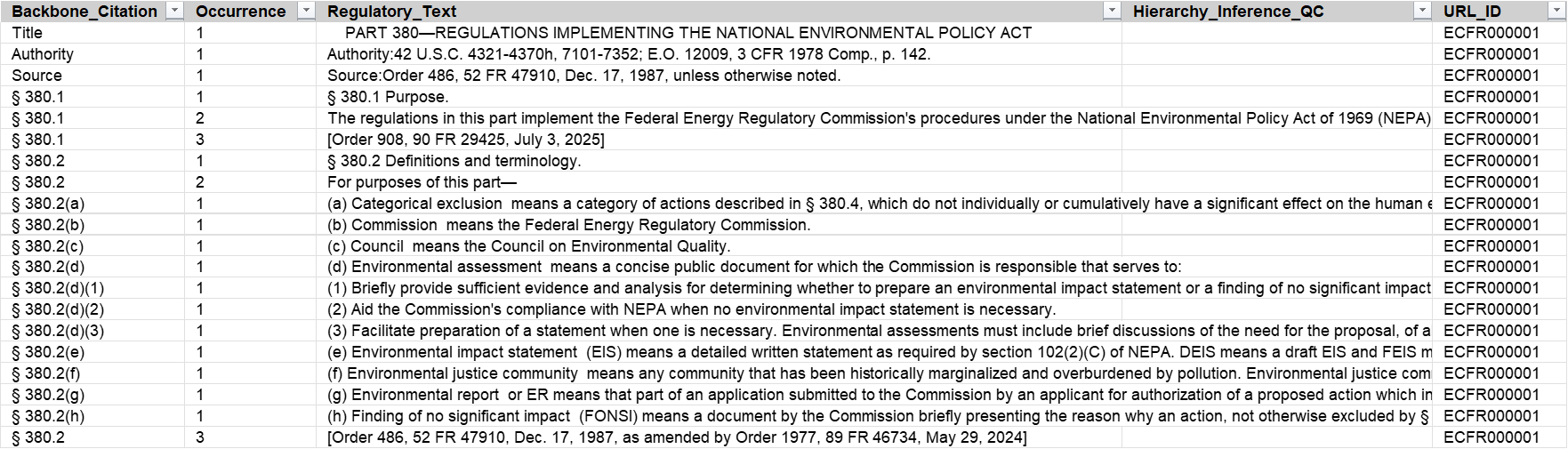
Example — Codified Text Retrieved and Structured in the URR
ART Workflow — Step 2: Develop the Statutory and Regulatory Attribute Registers (SAR/RAR)
ART uses expert-directed, AI-assisted analysis of the codified requirements in the Universal Requirements Register (URR) to identify and organize the statutory and regulatory attributes governing the administrative task.
The Statutory Attribute Register (SAR) identifies governing statutory subjects, actions, conditions, and policy objectives. The Regulatory Attribute Register (RAR) identifies corresponding regulatory citations, applicability criteria, required actions, definitions, and other attributes necessary to evaluate project information.
ART distinguishes generally applicable attributes from those specific to the current administrative task. The resulting registers provide structured, citation-linked criteria for deterministic retrieval of potentially responsive information from project submissions.
An expert reviews and confirms the selected attributes before their use in subsequent workflow steps, preserving traceability between the governing statutory and regulatory text and the criteria used to evaluate project information.
Example — Statutory and Regulatory Attributes for NEPA Alternatives Review
Statutory Attribute Register (SAR): NEPA §102(2)(C) — Environmental impact analysis, alternatives evaluation, technical and economic feasibility, and environmental consequences.
Regulatory Attribute Register (RAR): 18 CFR §380.12(l) and Appendix A to Part 380, Resource Report 10 — No-action alternative, system alternatives, route alternatives, comparative environmental impacts, and technical and economic considerations.
Step 2 Deliverable: Expert-reviewed SAR and RAR containing the statutory and regulatory attributes, governing citations, and task-specific criteria required for deterministic retrieval and subsequent requirement-to-evidence mapping.
ART Workflow — Step 3: Deterministically Retrieve Candidate Project Content
ART uses the expert-confirmed statutory and regulatory attributes in the Statutory Attribute Register (SAR) and Regulatory Attribute Register (RAR) to retrieve potentially responsive content from project submissions and supporting documents.
ART searches the project record using governing citations, defined terms, equipment and activity descriptions, and other expert-selected attributes. Deterministic retrieval identifies candidate text and associated document locations without relying solely on probabilistic inference to determine regulatory relevance.
Retrieved content is organized by the governing statutory or regulatory attribute and linked to its original source document, including available page, section, and file references. ART preserves the distinction between content identified as potentially responsive and evidence subsequently confirmed by an expert.
The resulting candidate content provides the source-linked information needed for requirement-by-requirement mapping in the next workflow step.
Example — Deterministic Retrieval of NEPA Alternatives Information
Governing attributes: NEPA §102(2)(C) and 18 CFR §380.12(l), including no-action alternatives, system alternatives, route alternatives, comparative environmental impacts, and technical and economic considerations.
Project information searched: Environmental reports, alternatives analyses, project descriptions, supporting technical studies, and other documents within the expert-defined submission record.
Candidate content retrieved: Passages addressing the proposed action, alternatives considered, comparative impacts, and supporting technical or economic information.
Traceability: Each candidate retains its associated SAR/RAR attribute, governing citation, source document, and available file location.
Step 3 Deliverable: A Candidate Content Register containing deterministically retrieved, citation-linked project information organized by statutory and regulatory attributes for subsequent requirement-to-evidence mapping and expert confirmation.
ART Workflow — Step 4: Map Candidate Content to Individual Regulatory Requirements
ART uses expert-directed, AI-assisted analysis to map the candidate project content retrieved in Step 3 to individual statutory and regulatory requirement sentences in the Universal Requirements Register (URR).
Each requirement is evaluated against the retrieved content using the governing citations, structured attributes in the Statutory Attribute Register (SAR) and Regulatory Attribute Register (RAR), and the relationships among applicable definitions, conditions, exceptions, and cross-references.
ART organizes the results into requirement-by-requirement tables displaying the governing citation, regulatory text, corresponding candidate project content, and its original document location. Multiple candidate passages may be associated with a single requirement, and individual passages may be relevant to multiple requirements.
Where potentially responsive content is not identified, ART preserves the requirement and records the absence of a retrieved match for subsequent expert evaluation. A missing match does not independently establish noncompliance or an incomplete submission.
The resulting mapping provides a traceable basis for expert assessment of regulatory applicability, completeness, and responsiveness without substituting automated inference for the expert's final determination.
Example — Requirement-to-Evidence Mapping for NEPA Alternatives Review
Governing requirement: 18 CFR §380.12(l) — Alternatives analysis.
Regulatory attributes: No-action alternative, system alternatives, route alternatives, comparative environmental impacts, and technical and economic considerations.
Candidate project content: Retrieved passages from environmental reports, alternatives analyses, and supporting technical studies addressing the identified attributes.
Requirement-to-evidence mapping: Each applicable requirement sentence is associated with potentially responsive project content and its source-document location.
Expert review status: Candidate match identified, multiple candidate matches identified, or no candidate match identified; all remain subject to expert confirmation.
Step 4 Deliverable: A Requirement-to-Evidence Mapping Register linking individual statutory and regulatory requirements to potentially responsive project content, source citations, and document locations for expert review and confirmation.
ART Workflow — Step 5: Expert Confirmation of Applicability, Completeness, and Responsiveness
ART presents the requirement-to-evidence mappings developed in Step 4 for expert review and confirmation. Each mapping displays the governing statutory or regulatory citation, individual requirement sentence, potentially responsive project content, and original source-document location.
The expert evaluates whether each requirement applies to the proposed project and whether the mapped content adequately addresses the applicable requirement. The review considers governing definitions, applicability conditions, exceptions, cross-references, and the technical context of the proposed activities and equipment.
For each requirement, the expert confirms or rejects candidate matches, identifies missing or insufficient information, and documents the basis for the determination. Where additional information is needed, ART preserves the unresolved requirement for further review rather than treating the absence of a match as evidence of noncompliance.
ART records expert determinations, supporting citations, review status, and any required corrections. Confirmed findings remain traceable to the governing requirements and original project submissions, providing a transparent basis for subsequent administrative review and decision-making.
Example — Expert Confirmation of NEPA Alternatives Review
Governing requirement: 18 CFR §380.12(l) — Alternatives analysis.
Candidate evidence: Project-submission passages addressing the no-action alternative, system alternatives, route alternatives, comparative environmental impacts, and technical and economic considerations.
Expert applicability determination: Confirm whether each identified requirement applies to the proposed project and review.
Expert completeness determination: Confirm whether the submission contains the information required to address each applicable requirement.
Expert responsiveness determination: Evaluate whether the submitted information substantively addresses the governing requirement, identifying any deficiencies or unresolved technical questions.
Review disposition: Confirmed, additional information required, not applicable, or further expert evaluation required, with supporting explanations and source citations.
Step 5 Deliverable: An Expert-Confirmed Requirements Review Register documenting applicability, completeness, responsiveness, supporting evidence, unresolved deficiencies, and expert determinations for the administrative record.